
FTC Disclosure:This post contains affiliate links.We’re independently supported by our readers and we may earn a commission when you buy through our links.

Search for a pair of hiking boots and you will find hundreds of listings that look identical in a thumbnail: brown leather, a lugged sole, a waterproof badge. The differences that actually decide whether the boot works for you sit one level up, in the brand. Brands share a last, a waterproofing system, an outsole supplier and a philosophy about how much break-in a buyer should tolerate. Two boots from the same maker usually feel more alike than two boots from different makers that happen to sit at the same position in a price band.
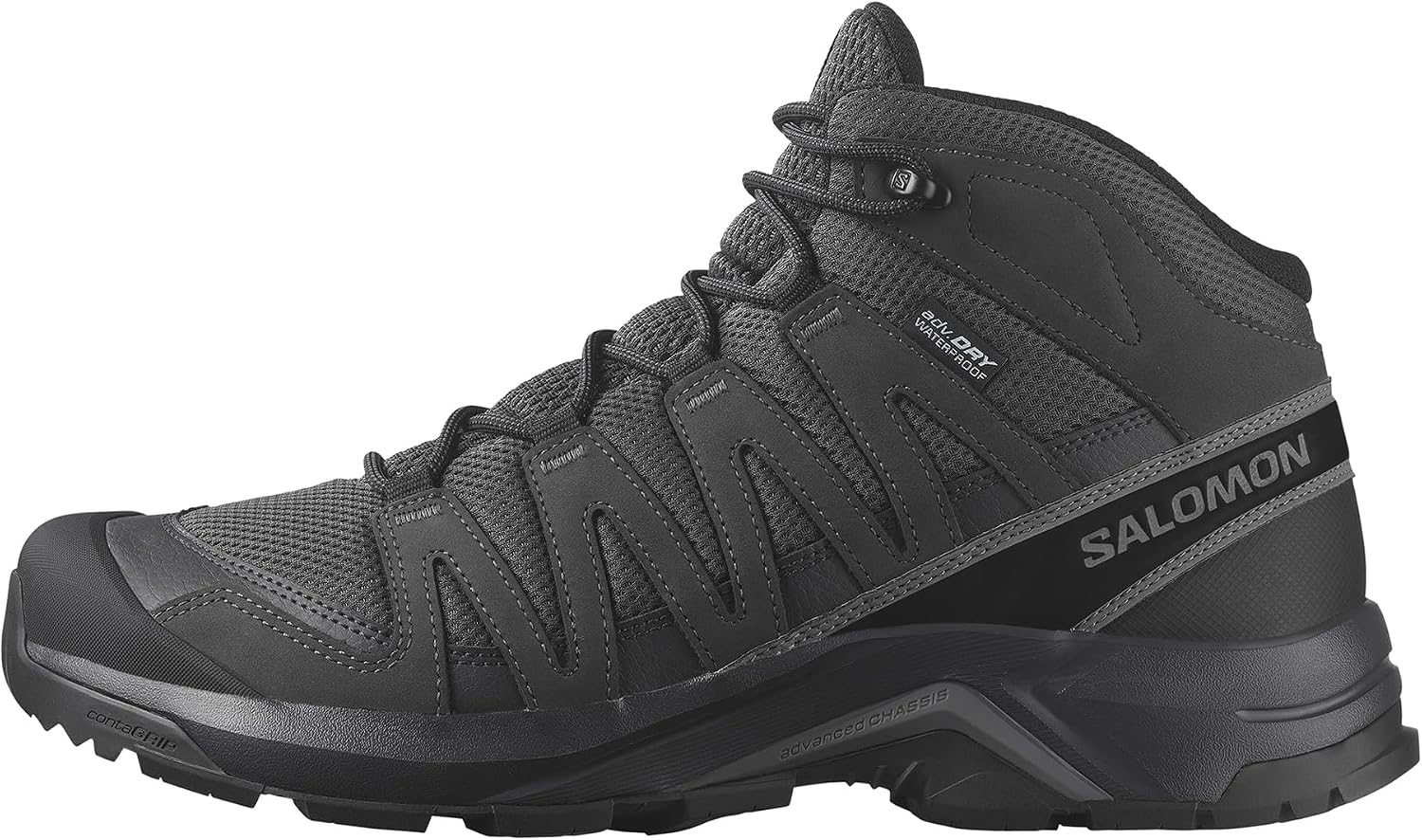
That is why this guide is organized by brand rather than by product. We picked five brands that between them cover almost every realistic men’s hiking-boot buyer: the hiker who wants comfort out of the box, the one who climbs steep wet rock, the one who wants a leather boot that looks like it was made forty years ago, the first-time buyer, and the buyer working to a tight budget. For each brand we explain what it stands for, where it stops being the right answer, and which model line is the sensible entry point.
Each brand is represented below by one current model that is easy to find on Amazon, so you can open the listing, check the size chart and confirm availability in one place. We deliberately do not quote prices and we do not print star ratings: Amazon pricing moves daily and a number written into an article is wrong within weeks. Decide on the brand and the fit first; the listing will carry the rest.
At a Glance: The Five Brands
| Award | Brand | Signature Model | Best For |
|---|---|---|---|
| Top Pick | Merrell | Moab 3 Mid Waterproof | Wide feet and all-day comfort |
| Best for Technical Trails | Salomon | X-Adventure Recon Mid Gore-Tex | Steep, rocky and wet ground |
| Best Heritage Look | Timberland | White Ledge Mid Waterproof | Classic leather, town to trail |
| Best for Beginners | Columbia | Newton Ridge Plus II Waterproof | A first pair for easy day hikes |
| Best Budget Pick | NORTIV 8 | Ankle High Waterproof | Occasional hiking on a tight budget |
Brand-by-Brand Comparison
Read this table as a filter, not a ranking. If your foot is wide, row one and row five are your rows. If your hikes involve wet rock slabs and you move fast, row two is the one that matters. The right answer is the row that matches your foot shape and the terrain you actually walk on, not the row at the top.
| Brand | Origin and Heritage | Waterproofing | Fit Profile | Standout Trait |
|---|---|---|---|---|
| Merrell | Founded in Utah in 1981 by a custom bootmaker | M Select DRY membrane | Roomy, wide-friendly | Shortest break-in of the five |
| Salomon | Annecy, France, 1947, with a ski-equipment background | Gore-Tex membrane | Precise, on the narrow side | Contagrip rubber and Quicklace |
| Timberland | New England roots, the yellow boot since the early 1970s | Waterproof full-grain leather | Standard, generous | Leather build that can be resoled |
| Columbia | Portland, Oregon, 1938, started as a rainwear maker | Omni-Tech membrane | Standard, neutral | Deep size runs and easy availability |
| NORTIV 8 | A younger brand built around online outdoor sales | In-house waterproof membrane | Standard, slightly wide | Most capability per dollar |
1. Merrell — The Comfort Benchmark
Best for wide feet, long days and anyone who refuses to spend two weeks breaking in a boot.
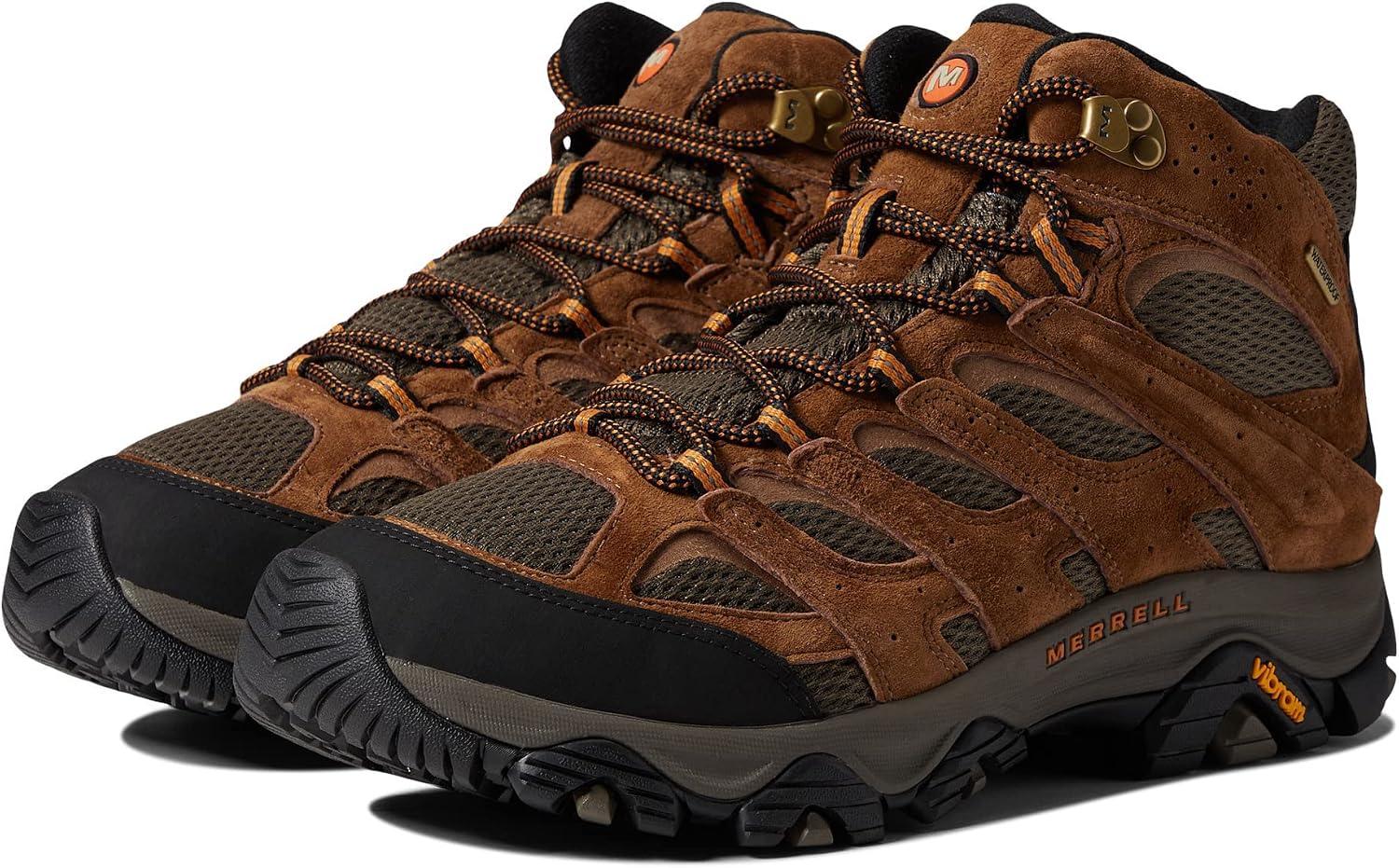
Merrell began in 1981 in Utah, and it began as a boot-fitting business rather than a marketing exercise: Randy Merrell was building custom boots for hikers whose feet did not fit anything off the shelf, and when Clark Matis and John Schweitzer took the company commercial, the founding idea survived intact. The brand still behaves as if the last matters more than the logo, which is why a Merrell either fits you immediately or it does not fit you at all. There is very little middle ground.
The Moab line is the clearest expression of that philosophy and has been the brand’s volume seller for well over a decade. The Moab 3 Mid Waterproof is a mid-cut leather and mesh boot on a Vibram TC5+ outsole, with an M Select DRY membrane. Mid-cut here means real ankle coverage without the stiffness of a full mountaineering boot, and the padding around the collar and tongue is generous enough that most buyers can walk a full day on the first outing.
Where this brand wins is the forefoot. Merrell’s last runs wide through the toes, so people who normally buy a wide width elsewhere can often wear a standard Merrell, and people who have given up on hiking boots because “everything pinches” tend to end up here. The trade-off is weight: a Moab is not a light shoe, and the silhouette is unmistakably practical rather than sharp. If you want a boot that looks good with chinos in town, this is not the row for you.
On terrain, the Moab family is happiest on maintained trails, forest paths, gravel and moderate rock. The Vibram compound prioritises durability over ultimate wet-slab grip, so on slick, steep granite a more technical brand will feel noticeably more secure. For the majority of American day hiking, that is a fair exchange, because the boot you keep wearing is worth more than the boot with the better laboratory number.
Signature line: Moab 3 Mid Waterproof
Waterproofing: M Select DRY membrane
Outsole: Vibram TC5+
Fit character: Roomy forefoot, wide-friendly
Best for: Day hikes, long walks, wide feet
2. Salomon — The Technical Option
Best for steep, rocky and wet terrain, and for hikers who move quickly and want feedback from the ground.
Salomon started in Annecy, France, in 1947 as a ski-binding company, and that origin explains almost everything about how its hiking footwear behaves. Ski equipment is engineered around precision and lateral control, and when Salomon moved into trail running in the 1990s and then into hiking, it carried that mindset across. The result is a family of boots that feel closer to a running shoe with ankle support than to a traditional leather hiker.
The X-Adventure Recon Mid Gore-Tex is the approachable end of that range. You get a genuine Gore-Tex membrane rather than an in-house laminate, a Contagrip rubber outsole tuned for mixed and wet surfaces, and the protective rand and reinforced toe that the brand uses across its trail line. It is lighter and more flexible underfoot than a Moab, and it turns over quickly on undulating ground.
The catch is the fit. Salomon’s last is precise and on the narrow side, with a snug heel and a secure midfoot. That is exactly what you want on a traverse where your foot must not slide inside the boot, and exactly what you do not want if you have a high instep or a wide forefoot. If you are between sizes or broad across the toes, going up a half size is the usual fix, and trying the listing’s size chart before ordering is worth the two minutes.
This is also the brand to look at if you have been hiking in trail runners and want a little more protection without giving up the feel of the ground. It is not the brand to look at if you want a boot that will still look current in ten years, because Salomon redesigns aggressively and its visual language follows its own logic.
Signature line: X-Adventure Recon Mid Gore-Tex
Waterproofing: Gore-Tex membrane
Outsole: Contagrip rubber
Fit character: Precise, narrow, secure heel
Best for: Technical trails, fast hiking, wet conditions
3. Timberland — The Heritage Workhorse
Best for buyers who want a leather boot with a real construction story and a look that has not changed.
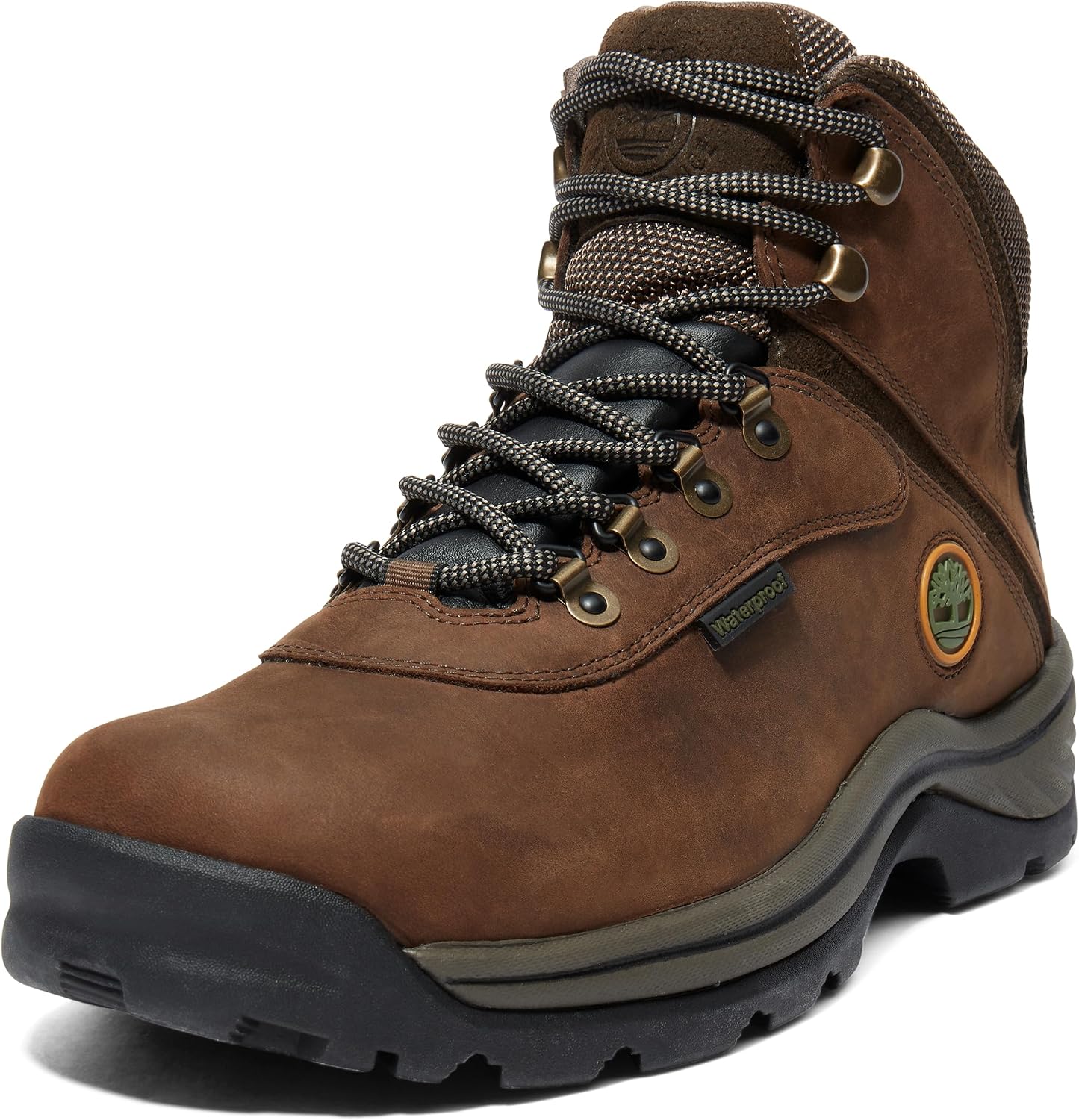
Timberland’s roots run back to the Abington Shoe Company in New England in the 1950s, and the brand took its current name in the early 1970s when the waterproof yellow boot became a product people recognised on sight. That heritage is not decoration: the company built its reputation on waterproof leather construction at a time when most outdoor footwear was either rubber or untreated leather, and that competence is still the reason to buy the brand today.
The White Ledge Mid Waterproof is the entry point into that lineage for hiking rather than workwear. It is a full-grain leather mid-cut with a padded collar, a removable footbed and a lugged rubber outsole, and it is sealed as waterproof leather rather than wrapped in a membrane. The difference is real: a leather boot breathes less than a Gore-Tex boot in hot weather, but it takes abrasion and scuffing far better, cleans up with a brush and a bit of wax, and can usually be resoled rather than thrown away.
Compared with a Merrell, the White Ledge asks for patience. The leather needs a week or two of short walks before it stops feeling stiff across the flex point, and the sole is firmer underfoot. Buyers who follow the old advice of wearing them around the house for a few evenings are usually happy; buyers who take them straight onto a ten-mile trail often are not. That is a property of leather boots generally, not a defect of this one.
Terrain-wise, this is a town-to-trail boot. It handles gravel paths, field edges, light snow and wet grass well, and it is the only boot in this group that looks deliberate with jeans. On steep rock and loose scree it gives up ground to Salomon and to Merrell’s more aggressive outsoles.
Signature line: White Ledge Mid Waterproof
Waterproofing: Waterproof full-grain leather
Outsole: Lugged rubber
Fit character: Standard with a generous collar
Best for: Light trails, wet grass, town-to-trail use
4. Columbia — The Easy Entry Point
Best for a first pair, casual day hikes and buyers who want easy sizing and easy returns.
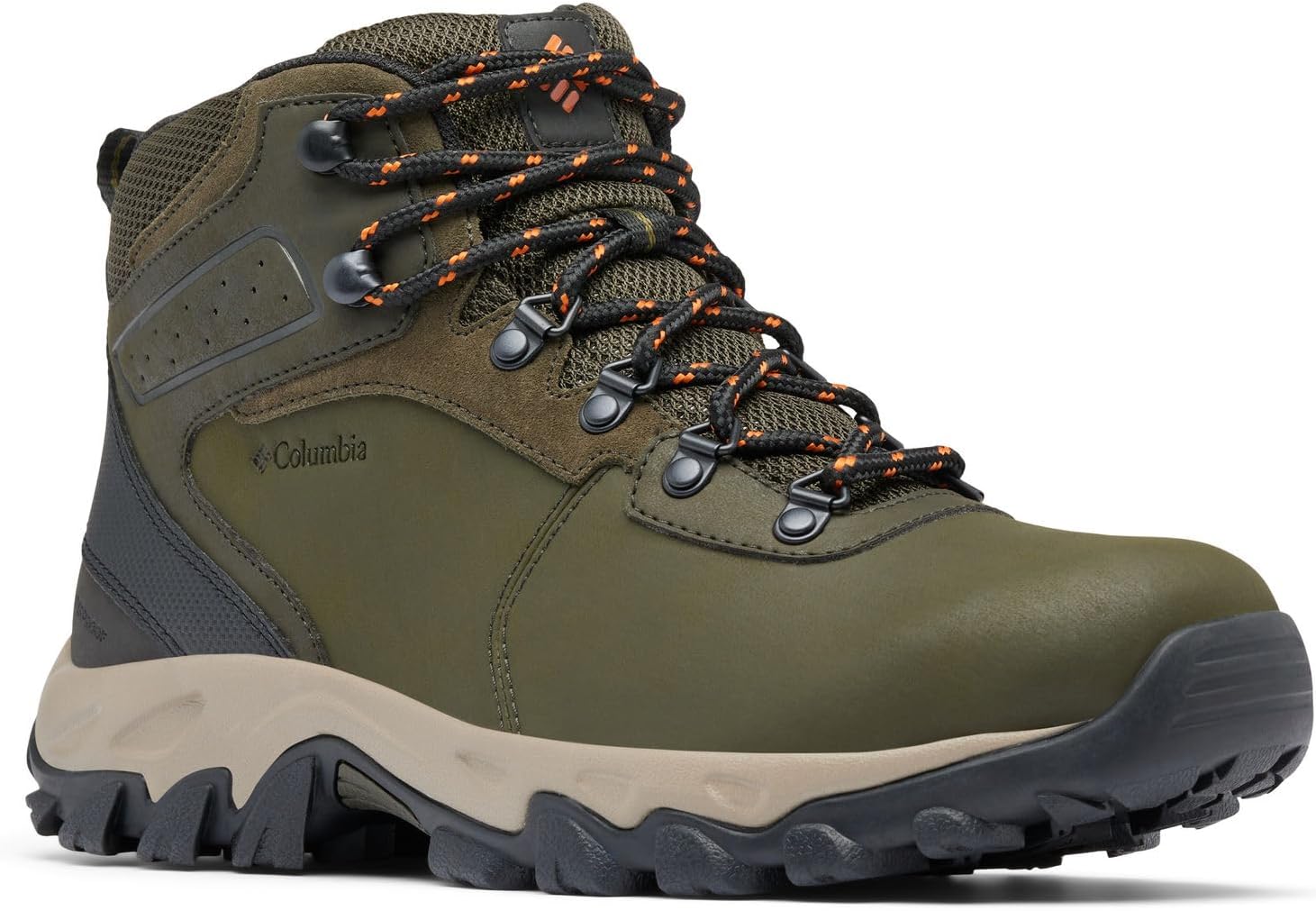
Columbia began in Portland, Oregon, in 1938 as a hat company that made rainwear, which is why waterproofing has always been central to the brand rather than a feature added later. The company grew into one of the largest outdoor labels in the United States by being broadly competent and broadly available, and its hiking footwear reflects that: nothing is extreme, everything is reasonable, and you can find your size.
The Newton Ridge Plus II Waterproof is the brand’s long-running entry hiking boot: a leather and textile mid-cut with an Omni-Tech waterproof breathable membrane, a padded tongue and a moderately aggressive outsole. It is not the lightest boot here and not the stiffest, and that middle position is precisely why it works as a first pair. Nothing about it demands that you already know how to hike.
The practical advantage is availability. Columbia runs deep size and width coverage and the model is stocked widely, so a buyer who needs a specific size in a specific colour has a realistic chance of getting it without waiting. For anyone who has been burned by a boot that only came in three sizes, this matters more than a marginal difference in sole stiffness.
Where it gives up ground is under load. The platform is comfortable for day hikes, established trails and wet weather walks, but it lacks the lateral rigidity that a heavy pack and rough ground demand, and the neutral last will not suit genuinely wide feet the way a Merrell does. Treat it as an excellent first boot and a fair second boot, not as a mountain boot.
Signature line: Newton Ridge Plus II Waterproof
Waterproofing: Omni-Tech membrane
Outsole: Moderately lugged rubber
Fit character: Standard, neutral
Best for: First boots, day hikes, wet-weather walking
5. NORTIV 8 — The Budget Standout
Best for occasional hikers and buyers who want a waterproof boot without paying heritage-brand money.
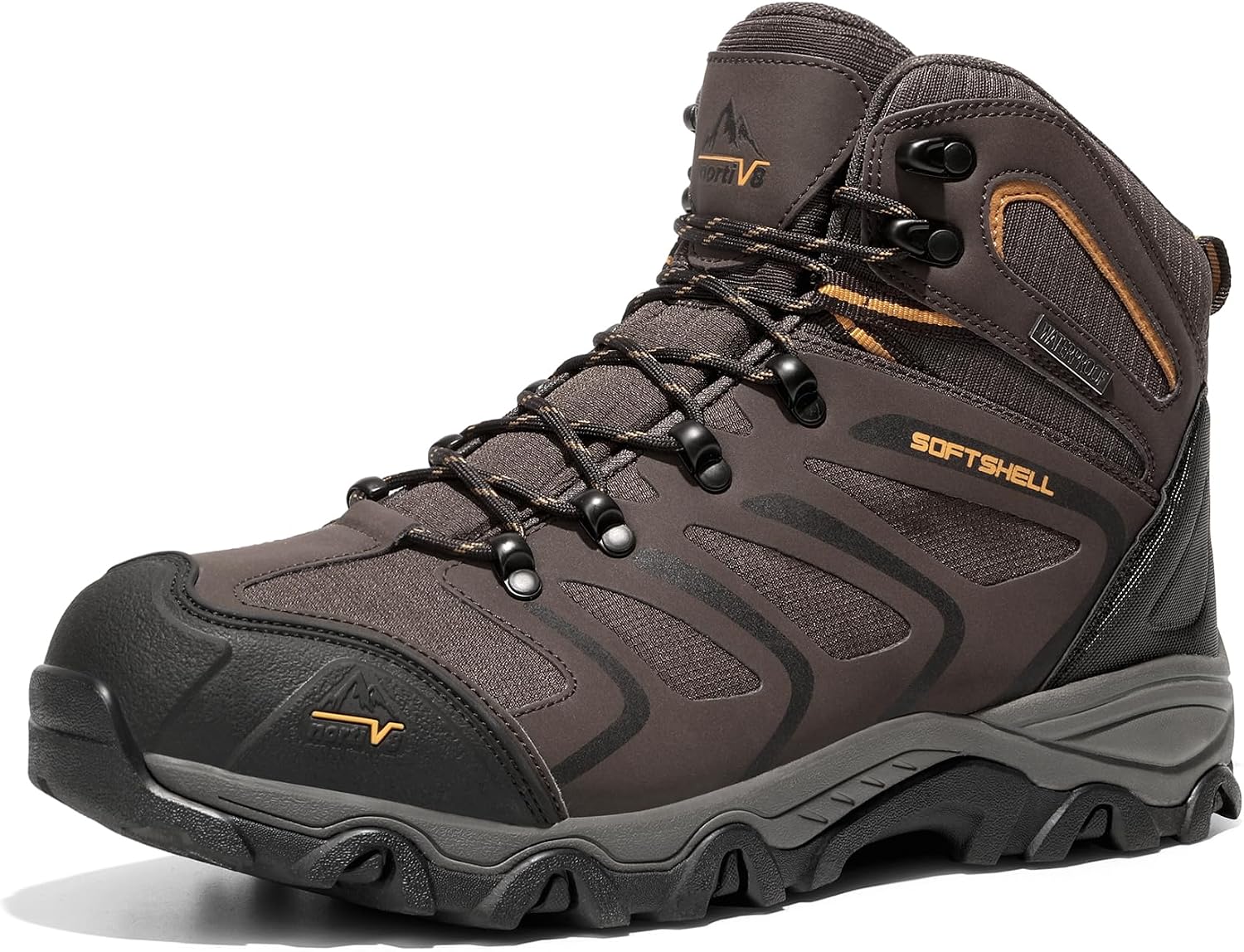
NORTIV 8 is a much younger name than the other four, built around online outdoor sales in the mid-2010s. It does not have a sixty-year archive, and it does not pretend to. What it does have is a straightforward proposition: put a waterproof membrane, a padded mid-cut upper and a lugged outsole on a boot and sell it at a level that lets a casual hiker say yes without deliberating for a month.
The Ankle High Waterproof is the model most buyers land on. It is a mid-cut synthetic and mesh boot with a waterproof membrane, a cushioned collar and a rubber outsole with a tread pattern that handles mud and gravel adequately. On a maintained trail in wet weather it performs well enough that most people will never notice the difference between it and a boot that costs several times as much.
The honest limits are durability and consistency. The materials are lighter-grade than the heritage brands, the midsole foam compresses sooner under a heavy hiker, and long-term shape retention is not in the same class as a full-grain leather boot. If you hike twenty weekends a year, you will probably replace these sooner than you would a Timberland. If you hike five, that calculation looks very different.
Its fit runs standard to slightly wide, which makes it friendlier than Salomon for broad feet and less precise for narrow ones. Buyers between sizes generally go up a half size. For a first boot, a spare pair for guests, or a trip where the boot might get destroyed in mud, this is the row that makes the least financial sense to skip.
Signature line: Men’s Ankle High Waterproof
Waterproofing: In-house waterproof membrane
Outsole: Lugged rubber
Fit character: Standard to slightly wide
Best for: Occasional hiking, first pair, spare pair
How We Chose These Five Brands
This is a coverage exercise, not a popularity contest. Five brands is enough to give almost every buyer a defensible starting point, and it is small enough that each entry could be checked properly rather than padded out.
Current availability on Amazon. Every brand is represented by a model that is listed and purchasable today, so the size chart and stock status you see are the ones that matter.
Different waterproofing approaches. Two of the five rely on a membrane, one on full-grain waterproof leather, one on a house laminate and one on an entry-level membrane. That spread lets you choose the construction, not just the badge.
Fit diversity as a hard requirement. A list where all five brands run narrow would be useless to half the audience, so the wide-last brand sits at the top of this guide by design.
Longevity and repairability considered. Where a brand supports resoling or has a stable sizing history, we say so, because the second owner of a boot is often the same person.
Why Trust Pliizy
We are not paid by any of these brands to place them here, and no brand has reviewed or approved this article. The order reflects how many readers each brand is likely to serve well, which is why the comfort-first option leads rather than the most technically exotic one.
Every model linked in this guide is sold through Amazon, and the links are affiliate links. If you buy through one, the site may earn a commission at no extra cost to you. That commission does not change the order or the recommendations, and it is the reason we can keep publishing without display advertising.
We also leave prices and star ratings out of the text on purpose. Both change constantly, and an article that quotes them becomes misleading within weeks. What does not change quickly is the character of a brand: its last, its waterproofing method and the kind of terrain it was designed for. That is what this guide describes, and that is what you should use to shortlist before you ever look at a listing.
How to Choose Between These Brands
Once the field is five brands, the decision reduces to four questions. Answer them in order and the shortlist usually collapses to one or two rows.
Start with your foot, not the trail
Measure your foot on paper at the end of the day and compare the width, not just the length. If your forefoot is broad or you routinely buy wide widths, Merrell and NORTIV 8 should be your first two listings. If your foot is narrow with a high arch, Salomon’s precise last is the one that will feel secure rather than cramped. Columbia and Timberland sit in the middle and suit most standard feet.
Match the boot to the terrain you actually walk
Be honest about the ratio of trail to pavement in your year. For maintained paths, gravel and wet grass, Columbia and Timberland are entirely sufficient and will be more comfortable than a stiff technical boot. For steep, rocky ground, sustained off-camber traverses and wet slab, the Salomon outsole and heel hold are worth the narrower fit. For long day hikes where comfort at mile twelve matters most, Merrell is the safer bet.
Decide between a membrane and waterproof leather
A membrane boot is cooler in warm weather and lighter, but the membrane is the part that eventually fails. A waterproof leather boot is warmer, heavier and needs maintenance, but it can be cleaned, waxed and resoled almost indefinitely. If you hike in hot, humid conditions, lean membrane. If you hike in cold, wet conditions and want one pair for years, lean leather.
Budget for break-in time
Merrell and most membrane boots are usable on day one. Full-grain leather needs a week or two of short walks before a long hike, and skipping that step is the most common reason people blame a boot for blisters. If your trip is in three days, buy the boot that needs the least break-in.
Check the size chart and the width options before ordering
Hiking footwear runs differently from sneakers, and the same nominal size varies between brands by close to half a size. Open the listing, read the size chart, and check whether a wide width exists in your size. For leather boots, allow for the sock you will actually wear, which is usually thicker than the one you tried them on with.
Do not buy a boot for a trip you have not planned yet
The most common mistake is buying a heavy technical boot for a first overnight and then finding it miserable on flat, well-graded trail. Buy slightly less boot than you think you need, and let the terrain tell you when to upgrade.
Frequently Asked Questions
The Short Version
If your feet are wide and your priority is comfort on the first mile and the twelfth, start with Merrell. If your hikes involve wet rock, steep ground and a faster pace, start with Salomon and check the size chart carefully. If you want a leather boot that will look right for a decade and can be repaired rather than replaced, Timberland is the answer. If this is your first pair and you want an easy, well-stocked option, Columbia removes most of the friction. And if the budget is the binding constraint and the hikes are occasional, NORTIV 8 is the honest choice rather than the compromise.
Whatever you pick, buy it early enough to walk it in, wear the socks you will actually hike in, and treat the waterproofing as maintenance rather than magic. The boot that fits your foot beats the boot that wins the comparison table, every time.


